“Extended magazine.” “High-capacity magazine.” “Large capacity ammunition feeding device.” These labels sound technical, but they were built for politics, not for the range. Most of the magazines they target are the standard magazines that ship in the box with today’s most popular rifles and pistols.
Standard, not extended
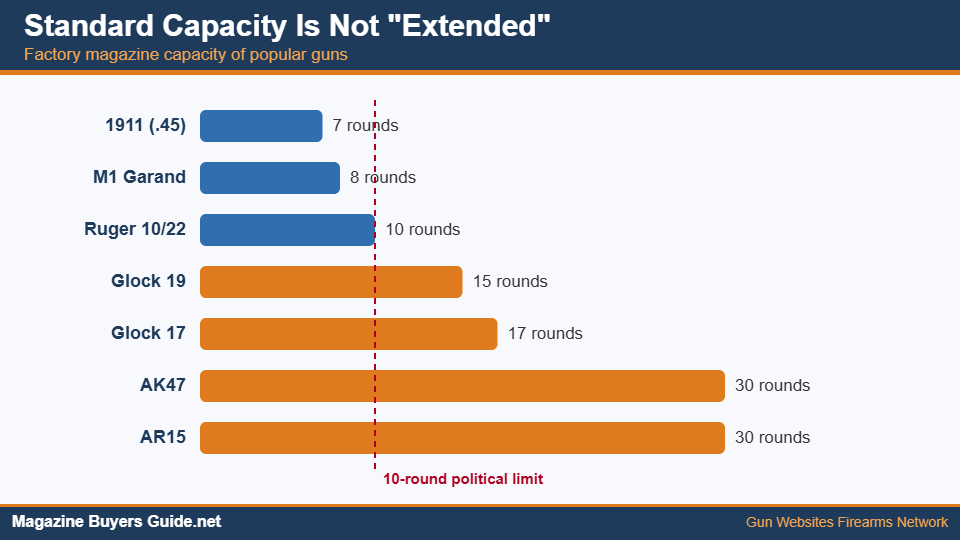
A Glock 19 is designed around a 15-round magazine. An AR15 is designed around a 30-round magazine. Those are factory standard capacities, not add-ons. A true extended magazine is one that sticks out past the grip or past a standard length, like a 33-round pistol magazine or a 60-round rifle magazine. Calling a factory 15 or 30-round magazine “high capacity” moves the line so ordinary gear can be treated as something dangerous and unusual.
How it started: the 1994 federal ban
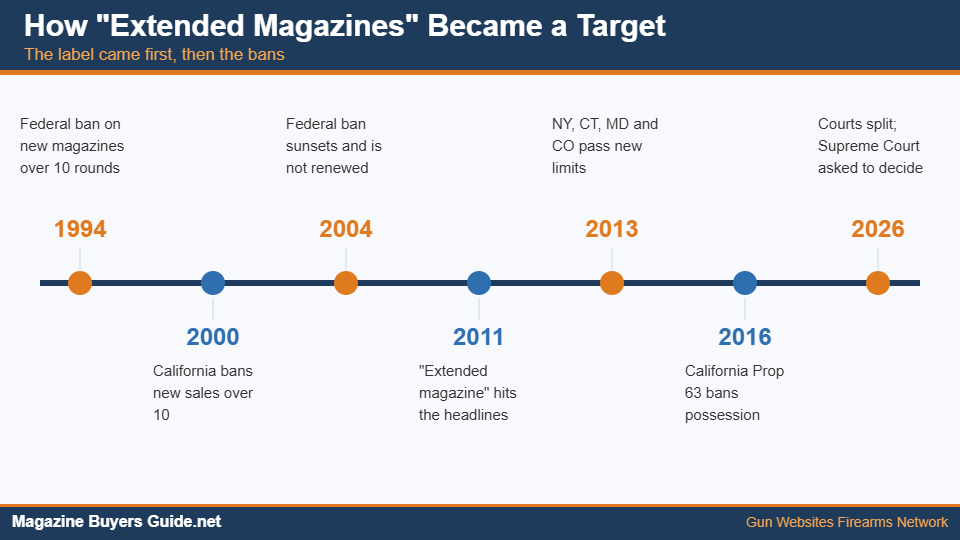
The term became law in 1994. The federal crime bill, signed that September, created a new legal category called the “large capacity ammunition feeding device,” defined as any magazine, belt, drum or feed strip made after the law took effect that could hold, or be readily converted to hold, more than 10 rounds. New ones could only be made for government and police use and had to be marked “RESTRICTED LAW ENFORCEMENT/GOVERNMENT USE ONLY.” Magazines made before September 13, 1994 stayed legal, so prices on pre-ban magazines shot up for ten years.
The number 10 was not based on any standard firearm design. It was a political line, and it has been copied into nearly every magazine law since.
2004: the sunset
The 1994 ban had a ten-year sunset clause. Congress did not renew it, and it expired in September 2004. Standard capacity magazines went back on store shelves nationwide, and gun owners have bought them by the tens of millions since.
2011: “extended magazine” enters the headlines
“Extended magazine” became a national talking point after the January 8, 2011 shooting in Tucson, Arizona, where the attacker used a Glock 19 with a 33-round magazine. Within days, federal bills were introduced to bring back the 1994 ten-round limit. They were sold as a ban on “extended clips,” but they reached far past 33-round magazines to cover the standard magazines in millions of homes. Those bills failed, but the language stuck, and “extended” and “high-capacity” have been used in nearly every gun control push since.
The state bans
With no federal ban, the fight moved to the states. California banned new sales of magazines over 10 rounds starting in 2000, then voters passed Proposition 63 in 2016 to ban possession of magazines people already owned. Colorado set a 15-round limit in 2013. New York, Connecticut, Maryland and New Jersey followed with their own limits, and more states have joined since, including Virginia, whose 15-round limit on sales took effect in July 2026. Today about 14 states plus the District of Columbia have some kind of magazine limit, most set at 10 rounds. The other states have none.
Some of these laws go after magazines that were bought legally years ago, forcing owners to sell them out of state, permanently modify them, or turn them in.
In the courts
Gun owners have fought back. Duncan v. Bonta, the challenge to California’s ban, has been in court since 2017. In 2025 the Ninth Circuit upheld the ban by calling magazines “accessories” rather than arms. In July 2026 the Third Circuit went the other way on New Jersey’s 10-round limit, holding that magazines are arms protected by the Second Amendment, and then paused its ruling while New Jersey appeals. That split between the circuits is the kind of conflict the Supreme Court exists to settle, and the Duncan petition has been waiting on the Court’s docket while it takes up challenges to AR15 bans this term.
Magazine Buyers Guide.net will update this page as the courts rule. Before you buy or travel, check the current law where you live and where you are going.

Why it matters
- Standard capacity magazines are the most common magazines in America, used for home defense, competition and training.
- A defender facing more than one attacker, under stress, misses more than they hit. Capacity is a safety margin.
- Every limit sets a number that can be lowered later. New York’s 2013 law tried to cap owners at 7 rounds loaded until a federal court struck that part down.
- Words shape laws. Calling standard gear “extended” is the first step to banning it.
Follow the fight for the Second Amendment across the Gun Websites Firearms Network.